

This article is long overdue and concerns the Muicle plant I first came accross when travelling for dyes in Mexico’s Teotitlan del Valle in October 2024.


I am a natural dyer and I specialise in learning and teaching about Indigo, Always on the look out for more information about Indigo baring plants, Indigo processes or resources I became very excited when discovering it. At first I mistook it as a form of wild Indigo. It has been a long journey of discovery and finally I think I am clear about what this plant is… read on if you want to know wether it is a dye plant for blue or an Indigo yielding plant. Many are very confused by it including in the academic and dyeing communities.
Muicle, never heard of it…
In Mexico, It is Muicle, sometimes called Muitle, but elsewhere in the countries of Mesoamerica it is often called Sacatinta, Moyotle, Moyotli…this causing much confusion, it’s scientific name is Justicia Spicigera but few dyers ever call their plants by their scientific names it is the Mexican Honeysuckle. It bears beautiful trumpet flowers in bright orange and attract the honey birds despite the fact it bears no scent unlike other Honeysuckles.
Carry Sommers a British textile expert and Fashion Revolution extraordinaire incorporated it in the dictionary of Plant, Fiber and Colours she wrote when travelling in South America with a Churchill Fellowship grant a while ago but she called the plant Sacatinta. And although I read it after coming back from Mexico I never connected the two plants until… I listened to a talk by a dyer from the community of San Juan La Laguna in Guatemala describing her dyeing process and it suddenly became clear that we were talking about the same plant. Natural dyers have to do a good bit of detective work sometimes to understand what they are working with.
It is the Mexican Honeysuckle and for many ordinary people from Mesoamerica it is a natural remedy.
I found it first in the local food market in Oxaca in the form of a small sachet of dried leaves and wood pieces, when visiting the medecine woman stall. The stall owner explained to me via google translate that it was good for my blood and I should make tea from it (It will be red she said). My companion for the day who is fluent in both Spanish and English explained that it was a good remedy for ailments such as diabetes (it controls blood sugar) or cholesterol, that some used it as a detox drink. It cleans you up… there were other tea/dyes in little sachet but this one captured me. I read later that it was full of anti oxidant, but also had a good level of flavanoids, and tannins, music to my dyers ears.
A few days later I was meeting Roman Gutierrez-ruiz a master dyer from Teotitlan del valle with who I would be exchanging knowledge and he introduced me to his Muicle Indigo vat first and his Muicle plant second.
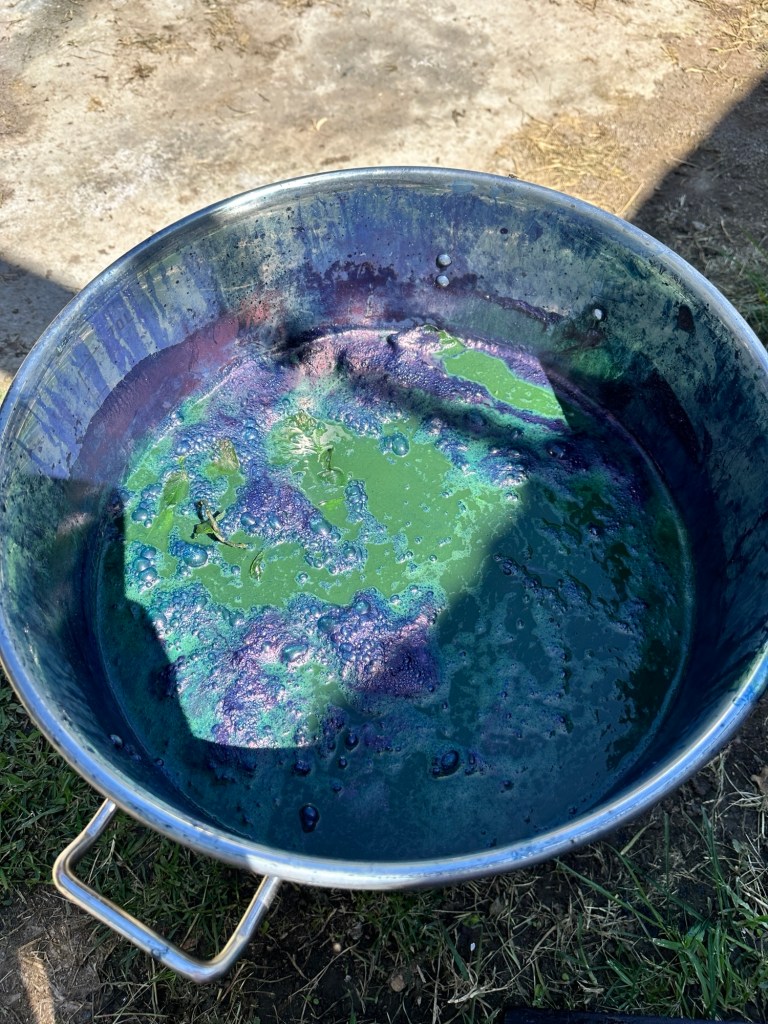
The first was a gorgeous large Indigo vat with leaves floating on the surface that produced vibrant blues like those from the Sukumo vats I used in Japan.
I was told this was an historic fermentation vat (based on bacteria fermentation in opposition to reduction of the sugar vats I normally use) It was made according to a traditional recipe using the local Mexican Indigo pigment and the Muicle plant, that the plant could produce blue too in its leaves and when “boiling it”.
I became quite confused to what this plant really was. Between my nearly-non existant Spanish language and Roman timid English some of the nuances of the dyeing process became fuzzy.
I meant to look it up when back to my studio but at first I could not find any detailed references on it, neither online nor in my trusted books such as Dominique Cardon… and my research using the name “Muicle” remained stagnant for a few weeks until I realised that most dye information could be obtained when searching using “Sacatinta”
Sacatinta is listed in Dominique Cardon “Natural dyes” … it helped me greatly to understand better what Muicle is. Dyers in Guetamala offer experiences with Sacatinta to tourist and products online dyed with it.
So is Muicle a type of Indigo or a dye plant producing blue ?
When looking for sources of information, I am keen to only report serious papers written by researchers, masterdyers and to leave alone the “hear say” knowledge vastly available on youtube and other casual platforms. For that reason I first searched my copy of Dominique Cardon “Natural Dyes” but nothing was listed for Muicle. However, Sacatinta was there with a very detailed and interesting description.
It is listed as a shrub cultivated in Guatemala and other regions of Central America such as Mexico, Honduras, El Salvador and Costa Rica. But I do know that it is also cultivated in California. It has large flat leaves and trumpet orange flowers. It is sensitive to freeze but can live in the cold. So it has the potential to live in Europe as being able to handle temperature down to – 3 C
It has been traditionally used for dyeing (leaves only) a variety of shades of purple and blue on fabric treated in an alkaline environment. With Alum it gives yellow. It has an active part in the making of the Pre-hispanic Indigo vat using Mexican Indigo pigment and fermentation, in it it seems to have a role in helping reducing the pigment into dye. Indeed some recent research show that despite not baring Indigo pigment precursors and therefore not being on its own able to generated a vat, it contains enzymes that can generate reduction. A very interesting academic (see below) written by Japanese researchers carried very precise tests on the leaves that give us clues to how best use it.
It is a fact that traditional community dyers usually have a excellent method in place that is passed down generations but often they can not explain the chemistry behind their process…. It just works… one of the issues with relying on heritage only is that if the intergeneration link is broken the knowledge is lost.
In Mexico I have seen the Muicle plant used in very large fermented Indigo vats but I believe in other close by countries it is used as a dye by small communities such as the dyers/weavers of San Juan La Laguna illustrated in this talk by Rosalinda Tay for the Scottish Rockfield center
Although almost always cultivated where it will be used, in Roman’s garden it had a prime place, in Guatemala for example in some areas where the land is claimed for food growing or other more income generating crops it can be brought to local markets by growers from further afield and sold to the dyeing community.
Dominique Cardon lists it in the 2007 version of her book in the “Indigo, chapter 8” part. Yet she does not characterise it as Indigo because no presence of Indirubin nor Indigotin could be found. So we can say it is not a form Indigo but when is it useful to the vats building?
A group of Japanese researchers at the same period did an in depth study how the leaves behave in the dyeing process. It seems to show signs of “reduction/oxidisation” when the dye is used in an alkaline environment to produce blue just like the Indigo vat. The dyers describe the process as “the fabric comes out green and then in front of my eyes turns blue” … That is very similar to the Indigo oxidisation after dyeing.
The colour blue can vanish when the fibre is placed in an acidic environment yet comes back when the alkaline is introduced again. To most readers this will sound geeky but for me it is highly exciting details that sends me on a journey to Indigo.
For those of you who want to discover the serie of test done by the group of Japanese Academics please see the article below. You can google translate it by positioning your phone opened on the google translate app and taking a photo of each page.
It seems that the plant enhance the vat reduction process because of the enzymes contained in the structure of the leaves. It has the same effect than Woad leaves had in the 19th Century Indigo vat.
The Muicle leaves have a clear reducing agent that speeds up the fermentation/reduction of the Indigo vat and in the traditional recipe dating pre-hispanic time the leaves are very present.
After this research the comments made by Roman during my visit about “I can dye blue but only after boiling the leaves” suddenly make more sense.
How is Muicle used in the Indigo vat process:
Indigo is one of the most ancient dyes used in MesoAmerica and it would be great to develop her but I would just be copying what others have already explained much better and it is not my field. If you are interested to read about the ancient dyes used in Mexico you can read HERE an excellent paper by Mary Elizabeth Haude about early colorants used.
For me I am interested by the fact that there is a clear difference between the Indigo vats used before Mexico was colonised and after. The traditional vat is most definitively called “The Pre-hispanic vat” it is a fermented vat very similar to those used in Europe incorporating Woad even at the stage Indigo pigment from India was present. To those knowledgeable enough about the vat making process, Woad is used as a reducing agent because of the enzymes in its leaves.
The Muicle plant is the reducing agent in the Pre-historic vat and today is still cultivated and used by traditional dyers to fire up their vats. Independently to being a dye plant used for specific colour, the Muitle plant has this very important role of initiating and fixing Indigo vats. It is a seasonal plant and I have been explained that out of the season, traditional vats were not made so frequently.
How is the pre-hispanic vat made :
The traditional vats are made using local resources and the main colour ingredient is the Indigo pigment Anil extracted locally from the Indigofera Suffruticosa in the area of Santiago Niletepec. It is a back breaking process but the pigment is extracted using organic agents and the pigment produced generated vibrant blues. As it contains no lime it never looks muddy when dyed. The pigment which is available in hard pieces is ground using the traditional grinding granit stone.
I was told a Clay pot should be used for the fermentation and it could be as quick as one week if the temperature reaches around 30 degree C. If the weather is cooler then a longer timing will be necessary. It is not an exact science.
For your vat you will need:
Alkaline water + Anil/Indigo pigment + Mezcal + Muicle leaves all in a clay pot and good warm weather.
The vat is fermented and the bacteria keeps it alive. It needs alkaline water to be generated and the fermented plant of Muicle. This in turns allows the pigment to reduce and generates a dye vat. It is a slow process and although it rests on chemistry only the skilled dyer can make this happen. The vat can stay alive for as long as there is Indigo colour in it. The Muicle has to be replaces regularly. The blue generated is vibrant and the colour leaching from the plant leaves helps in securing a unique tone. –
- The alkaline agent is lye (ash water) and lime water (strain the water through the lime but do not add the lime to the vat, a most unusual concept for the westerners).
- Some local Metzcal (Agave local spirit) is used to help “wetting” the Indigo pigment.
- Muicle leaves are added to the vat
- A 60 litre vat is quite common.
The sequence is to the Alkaline water add the ground pigment, the mezcal and the leaves in the pot, close the lid and leave to rest for a week. Don’t open regularly or you loose the temperature. You could if you are using a stainless steel pot use some outside heat.
The vat is one of the most beautiful dye pot I have used, It is also fragile and should only be used for around one hour at a time unless you dye wool as is frequently done in Mexico. Because of the absence of lime there is no deposit/sludge at the base of the vat and the dyers tend to leave wool for a very long time in … sometimes as long as an overnight. The dye bath is quite alkaline and the wool has to get an immediate rinse when coming out and a acid rinse to neutralise the extra akaline environment.
How to dye purple and blue :
When using this plant for dyeing (with the leaves) if you place the leaves in water the liquid turns blue but shortly after (10 mn or so) in bright purple. You can dye cotton blue with it yet it is not an Indigo yielding plant. If using Alum you obtain yellow probably from the flavanoid of the plant.
When you rub the leaves on a piece of silk in a similar manner to the “Salt rubbing” method of the Japanese Indigo you can achieve very pale blue. The picked leaves that are allowed to dry very fast turn black so there is pigment there but not Indigo. You can also achieve this effect on cotton, this is not possible from Indigo leaves… this is most definitively a different pigment.
There has been a lot of discussion on wether or not it is pigment generating. The pigment is kept in colourless leaves but it generates colour in an alkaline environment and the Mexican dyers use Alkaline dye bath to capture the purple colour. If the piece dyed was rinsed in vinegar water this will affect the colour in a negative manner.
In order to dye a vivid blue the dye bath has to be brought up to 80 degree CC to extract but then to be brought back to room temperature. The colour is highly ph sensitive and bringing and taking away an alkaline agent in the process can dilute it or take it away together. Some of the researchers involved in its analysis have mentioned anthocyanins.
From my experience the purple is the more stable colour for this plant and its best usage is in the fermentation of the historic vat.
Unfortunately I was not in Mexico for long enough to experiment further with it. As I dont have photos of the beautiful blue you can obtain from it I have added here the blog post from a UK dyer Babs Behan who visited Mexico in 2021 and did some dyeing with it. Unfortunately she has slightly older information and confirms the presence of Indigo in her blog post. We know now it is not do… enjoy the photos HERE the colour is pretty incredable.
And finally if you want to discover a bit more fun facts about the Muicle… below a link covering how it is used today:
A very fun and light content about making healthy tea from the Muicle leaves and modifying its original colour with lemon Make tea here
If you visit Oaxaca, make sure to make your way to visit Roman Gutierrez, his studio is pretty incredable and he will share I am sure his fermented vat.
If you want the exact recipe for that vat email me bettysbeautifullife@gmail.com
Discover more from THE LANSDOWNE HOUSE
Subscribe to get the latest posts sent to your email.
 THE LANSDOWNE HOUSE