
Feeling blue, The exhibition

Feeling blue is an exhibition in the Glasgow Botanical garden in Septembre 2023. It was set up to celebrate the second anniversary of The Indigo plot the dye garden I curate in the Botanical garden. It is about fibre and dyes and there during the whole week end of 16/17th septembre we will celebrate blue…
As well as my own pieces listed below I have invited a number of dyers to contribute in sharing some of their work. Below is the detail as well as the list of the work exhibited. Photos will be added. All pieces are dyed with natural dyes which are grown or foraged. The focus of the dye is about the work. My own pieces are mainly Indigo and Woad dyed from this year.
ABOUT ME AND MY PIECES:
Elisabeth Viguie Culshaw, Natural dyer, Glasgow.
Trained by Christies in conservation stencilling turned to Natural dyes, grows a dye garden and shares her skills in classes online live on zoom and in person in Scotland and overseas.
I curate a Botanical printing project since 2020 “The True Colour of the Cotinus” I travel to South East Asia to learn and share skills.
Exhibition: A number of pieces dyed with Indigo and Woad dyed in 2023. Made in France, Bali and Scotland using a variety of Natural Indigo vats and Woad. Some Fresh leaves pieces.
The guests exhibitors:
Name: Julia Billings
Social media: IG @woollenflower, website www.woollenflower.com, email jules@woollenflower.com
Image:
Bio: Julia Billings is a craftsperson and horticulturist based in Bridgeton, Glasgow, where she runs a natural dye and textile studio, producing plant-dyed yarn and threads for craftspeople and facilitating workshops on dyeing, knitting, mending and other textile skills. With a particular focus on producing yarn and threads for other craftspeople, Julia hopes to facilitate the making of objects that are beautiful, comforting and long-lasting and to expand public perceptions on the range of shades that natural dyes yield. Woollenflower yarns are made from high-quality, natural fibres, such as minimally-processed local wools, alpaca, linen and kid mohair, and are dyed with plants collected around Glasgow and Scotland, as well as raw plant material and extracts,
using time-tested techniques to make long-lasting colour.
Description: These threads, which may be used for embroidery, weaving or any form of fibre work, form a joyful deviation from my/ Julia’s (please use whichever suits the style you’re using for these descriptions!) usual studio practice. The small hanks allow me/ her pull out the remaining colour from dyebaths used to dye larger volumes of yarn and to experiment with different dyes and combinations.
Dyes used : Madder, Pomegranate, Indigo, Woad, Weld.
Kathryn Tomasetti / Botanical Weaves
Website: www.botanicalweaves.com
Instagram: @botanicalweaves
Name of my piece and short description:
“Double Rainbow”
Handwoven scarf in mulberry silk (warp), and mulberry silk and silk/merino blend (weft). All fibres are secondhand.
The rainbow stripes have been naturally dyed using: woad (purple-y blue), Japanese indigo (light blue), Japanese indigo overdyed with Dyer’s camomile (green), Dyer’s camomile (yellow) and Coreopsis tinctoria (orange).
Short bio:
My textile creations are naturally dyed and handwoven entirely by me, Kathryn Tomasetti, at my Botanical Weaves studio in Lichfield, Staffordshire in the UK. I’m a mindful, sustainable, very passionate weaver, natural dyer and ecoprinter. All of my fibres are either sourced locally, are recycled/ reclaimed/ deadstock/ mill ends or secondhand. I use exclusively my own homegrown plants and flowers, or local plants that I forage responsibly and with permission.
Exact size of the piece sent:
94cm x 43cm, with 5cm of loose fringe on each tail
Alison Casserly
Instagram is @casserlyalison
Title -Betty
Description – A Gansey inspired cardigan knitted from British Bluefaced Leicester yarn, dyed with woad leaves grown in my Lincolnshire garden. According to legend Betty Martin was a Gansey knitter from Filey on the North Yorkshire coast who gave her name to this simple, textured stitch.
Size – width, across sleeve to sleeve 55”, if on a hanger with sleeves hanging down, width is 26”. Length is 23” maybe a little longer when it’s washed and blocked. (I’m aiming to have it finished this week and just have one sleeve to finish.)
Weight – approx. 600 – 650g
Bio – I am currently employed as a part time seamstress for a small local ladieswear company, but my main passion is for knitting, by hand and machine, knitwear design and I am collaborating and dyeing a small range of sock yarns for my local wool shop in Brigg, all inspired by local places and landmarks.
I also grow natural dye plants in my garden, close to the Lincolnshire Wolds While I grow Dyer’s Chamomile, Coreopis, Cosmos, Golden Rod and Madder, the beautiful blue dye from Woad is my main interest especially as it once was grown and processed all over the county. I am looking for a field or larger plot which will enable me to grow more plants than I am able to in my garden, hold workshops and save the pigment for future use.
Deanna Utter Grigus
Instagram @ growing_colour
Email: dug_art@mac.com
Title of piece: Eight shades of indigo
Dyed from fresh leaves of the Persicaria tinctoria plant with the salt method onto silk fabric. The greenish blue duller colors were from the first harvest in July and the brighter blues were from the second harvest in August. The very light blue was obtained from my plants that sprouted from left over seeds and never received any fertilizer only the occasional water. The darker the color the more dips in the indigo.
Bio:
Deanna is a photographer, artist, gardener, and natural dyer located near the forty-fifth parallel in the state of Wisconsin in the U.S.A. Her interest in natural dyes started in college and nearly four decades later due to the pandemic she had the time and online resources with inspiration from Elisabeth’s classes to really explore natural dye, learn to grow indigo, eco print, and extract pigment. “I love it all and it has brought me great joy and satisfies my curious nature, while giving me connections to others from around the world”. This year I joined other indigo enthusiasts in Minnesota and we rented a small piece of organic farm land where we are growing, weeding, and harvesting indigo. This has been a very laborious experience and we have learned a lot along the way with beautiful blue results.
CarolAnn J Allan
Instagram: carolannjallan
Slow textiles – Embroidery/Quilting, Stitched Shibori & Eco Printing
Artist/Tutor
“Mapping my Garden” Solar Dyed silk & cotton fabric & dyed silk threads with Blackberry, Daffodils, Bluebells, Onion Skins and Buddliea.
CarolAnn’s own practice explores the importance of Slow textiles and traditional skills, naturally dying her own fabrics and threads from her garden. She has started a small dye garden and her first year of growing Indigo (with Elisabeth)
My address is: Grange Court, Apperley Lane, Rawdon. LEEDS LS19 6LN
Size is; 33 x 27cm
WEST OF SCOTLAND GUILD OF WEAVERS, SPINNERS AND DYERS :
http://www.weave-spin-dye-glasgow.org.uk/
A blanket woven by the guild made of wool yarn dyed by members of local plants and Red yarn dyed with Eucaliptus from an Australian guild.
Deborah Gray:
Your name: Deborah Gray
www.deborahgraytextiles.co.uk Instagram: deborah.gray7
Dye garden bunting –
Length with flags 340cm plus over 1 metre of tape at either end for tying.
21 triangular flags, each 17cm wide x 18cm deep
Protected: The Indigo Plot, Growing Japanese Indigo and Woad in Scotland 2023 – Making a Woad vat and extracting pigment
Protected: Impressions Botaniques – Les formules
Protected: The French Retreat… the formulas
Protected: Leaves on paper 2023 – month 4 – steaming with ph sensitive dyes
Protected: Eco Printing on paper – basic notes, The Sculpture Studio workshop – May 2023
Call out for natural dyed work for September Glasgow exhibition Feeling blue: fibre and dye from The Indigo plot –
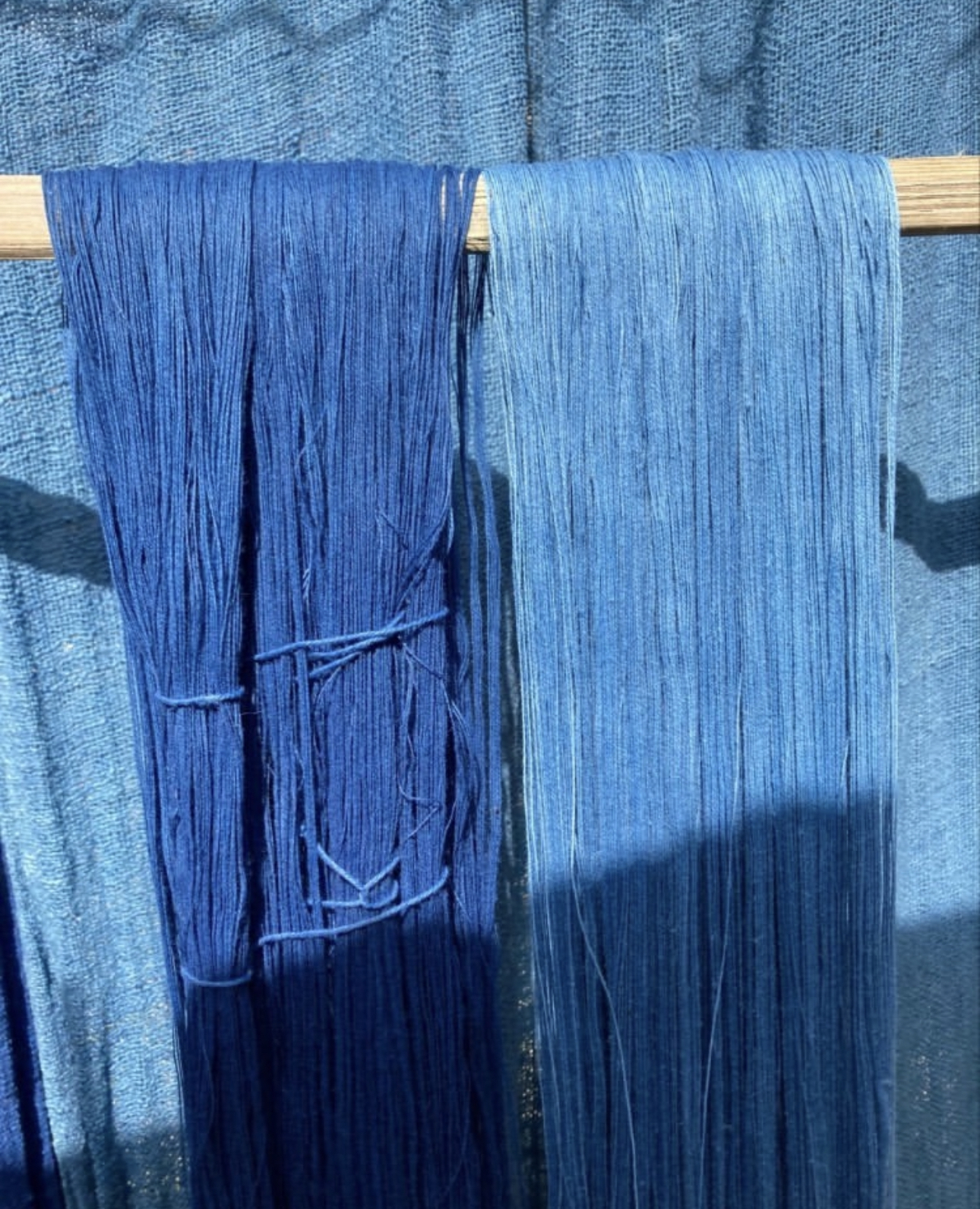
“Feeling blue fibre and dye from The Indigo Plot” is a natural dye exhibition curated by textile artist and natural dyer. Over the week end of the 16 and 17th septembre work produced using the Natural dyes grown in the dye garden will be exhibited.
This is a call out for dyed pieces using sustainable natural dyes (textile or paper) to create a rainbow of colours to be exhibited during that week end.
If you are a natural dye artist, or work with a community using natural dyes on fabric, yarn or paper we want to incorporate a piece of your work in our exhibition. It can be a dyed piece or a printed piece using natural dyes. The dyes have to be traceable and sustainable. This is about colour not artwork.
To apply please email Elisabeth @ bettysbeautifullife@gmail.com and state your preferred option (only one):
- a large piece of cloth or paper (60 cm x 120 cm)
- Some skeins of fibre (wool or flax, maximum 3)
- a small size piece 30 x 30 cm of cloth or paper.
Please include one to two photos of your work together with a description of how you use natural dyes in your work/process as well as your location.
Due to the limited space available in the exhibition space we are looking for about 20 pieces. We will accept applications until the 10th of July, selection will be done for the 24th and we will need to receive pieces during the first week of September.
If selected the work will have to be posted to Elisabeth unless otherwise agreed at your cost but will be returned to you at our cost after the exhibition. Work will be insured during the exhibition but not in transit.
You will be invited to visit to engage with the other dyers and you will be listed as participant to the event.
 THE LANSDOWNE HOUSE